
On this page
- Read the label before choosing a charger
- Keep chargers with the equipment they serve
- Choose a place where charging does not obstruct escape
- Use the manufacturer's temperature limits
- Protect loose cells and keep sets identifiable
- Build a charging routine around real use
- Stop using a battery that shows warning signs
- Use the right recycling route
- Battery safety checklist
- Sources
Rechargeable AA cells for a radio, a phone power bank and the battery inside an e-bike do not share one charging routine. They differ in chemistry, voltage, protection and intended use. Treating everything labelled "rechargeable" as interchangeable is an avoidable mistake.
Start by collecting the manuals and identifying the batteries already in the home. Leave fixed batteries inside their devices. This guide covers ordinary household care and preparation; it does not provide instructions for rebuilding packs, charging bare lithium cells or repairing damaged electronics.

Full image attribution
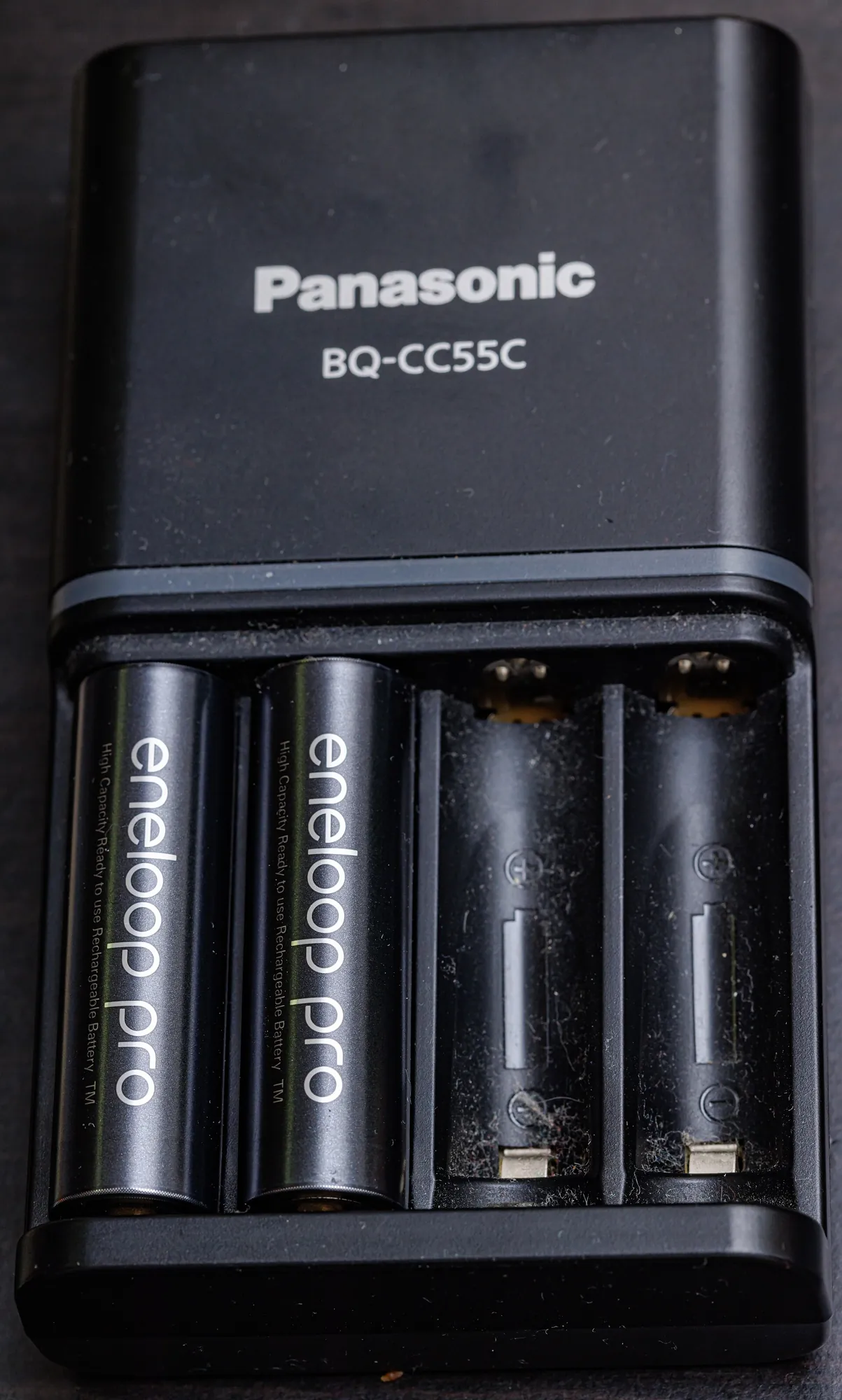
Panasonic ENELOOP PRO Ni-MH BATTERIES & BATTERY CHARGER BQ-CC55C.jpg — Dinkun Chen; CC BY-SA 4.0. Resized and converted to WebP; source: https://commons.wikimedia.org/wiki/File:Panasonic_ENELOOP_PRO_Ni-MH_BATTERIES_%26_BATTERY_CHARGER_BQ-CC55C.jpg
Read the label before choosing a charger
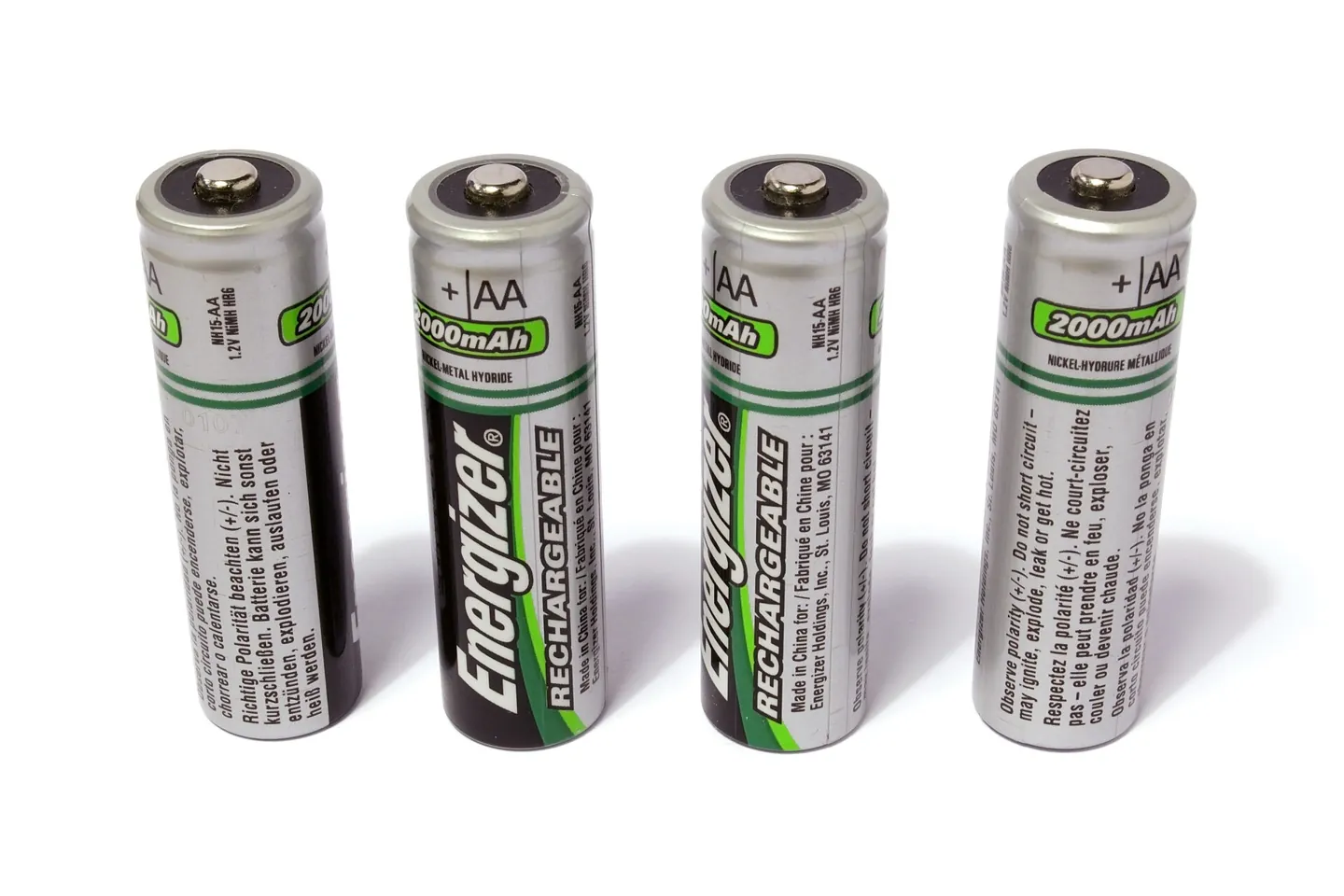
Look for the chemistry and model, not just the physical size. AA and AAA describe a shape, while NiMH describes a battery chemistry. A similarly shaped lithium cell can have a different voltage and may damage a device that expects ordinary AA batteries.
Many familiar rechargeable AA and AAA cells are nickel-metal hydride, written NiMH. Panasonic's eneloop guidance explains their nominal voltage and compatible charging requirements. Check the instructions for your own cells and device rather than applying one brand's charging rule to every product.
Power banks, phones and many portable power stations use lithium-based batteries. Some power stations use lithium iron phosphate, often written LiFePO4 or LFP. That remains a battery system with charging limits and safety instructions; a chemistry label does not make careless use safe.
Do not recharge disposable alkaline cells or other batteries marked non-rechargeable. Do not put an unidentified cell into a charger to discover whether it works. If labels are missing or the history is uncertain, seek the manufacturer's advice or an appropriate recycling route.
| Item | What to check | Avoid |
|---|---|---|
| NiMH AA or AAA cells | Charger explicitly supports the cells and device accepts their voltage | Using a charger intended for another chemistry |
| Phone power bank | Approved input, cable, condition and charging instructions | Opening the case or charging a swollen pack |
| Portable power station | Model-specific charging, storage and temperature limits | Assuming all solar inputs or battery packs are compatible |
| E-bike battery | Original system compatibility and approved charger | Conversion, repair or substitution using unidentified parts |
Keep chargers with the equipment they serve
Label a charger with its intended device if several look alike. A plug that fits does not establish matching voltage, polarity or charging control. Use manufacturer-approved equipment and obtain replacements from a reputable source.
Keep instructions with the charger or in an accessible offline folder. Record any setting that must be chosen by the user. If a charger supports several chemistries, the manual must explain exactly how the intended cells are recognised or selected; do not guess from a symbol on the display.
Inspect leads and connectors before use. Fraying, exposed conductors, crushed insulation or a damaged plug are reasons to stop using the charger. Tape wrapped around a failing lead is not a repair. Do not continue because the device still appears to charge.
London Fire Brigade's lithium battery advice is particularly relevant to e-bikes and e-scooters, where incompatible charging or altered batteries can have severe consequences. Do not apply a small power bank's habits to a large traction battery.
Choose a place where charging does not obstruct escape
Use a stable surface and the ventilation arrangements in the manual. Keep the device and charger uncovered and away from bedding, curtains and other easily ignited material. Avoid places where a cable will be trapped by a door or damaged by furniture.
Scottish Fire and Rescue Service advises against charging lithium batteries while asleep or away from home, and against charging in escape routes. Plan charging for a time when somebody is awake and can respond to a problem. Disconnect ordinary consumer chargers when charging is complete; see the separate guidance below for equipment designed to remain connected.
Do not create a charging station in a communal hall because it has a convenient socket. A fire there could affect other residents' escape. Ask the building manager about permitted arrangements for larger devices and keep fire doors and routes clear.
For equipment designed to remain connected continuously, such as a provider-supplied communications backup, follow its specific approved installation and maintenance instructions. Do not substitute an ordinary consumer power bank and assume continuous charging or pass-through operation is allowed.

Full image attribution
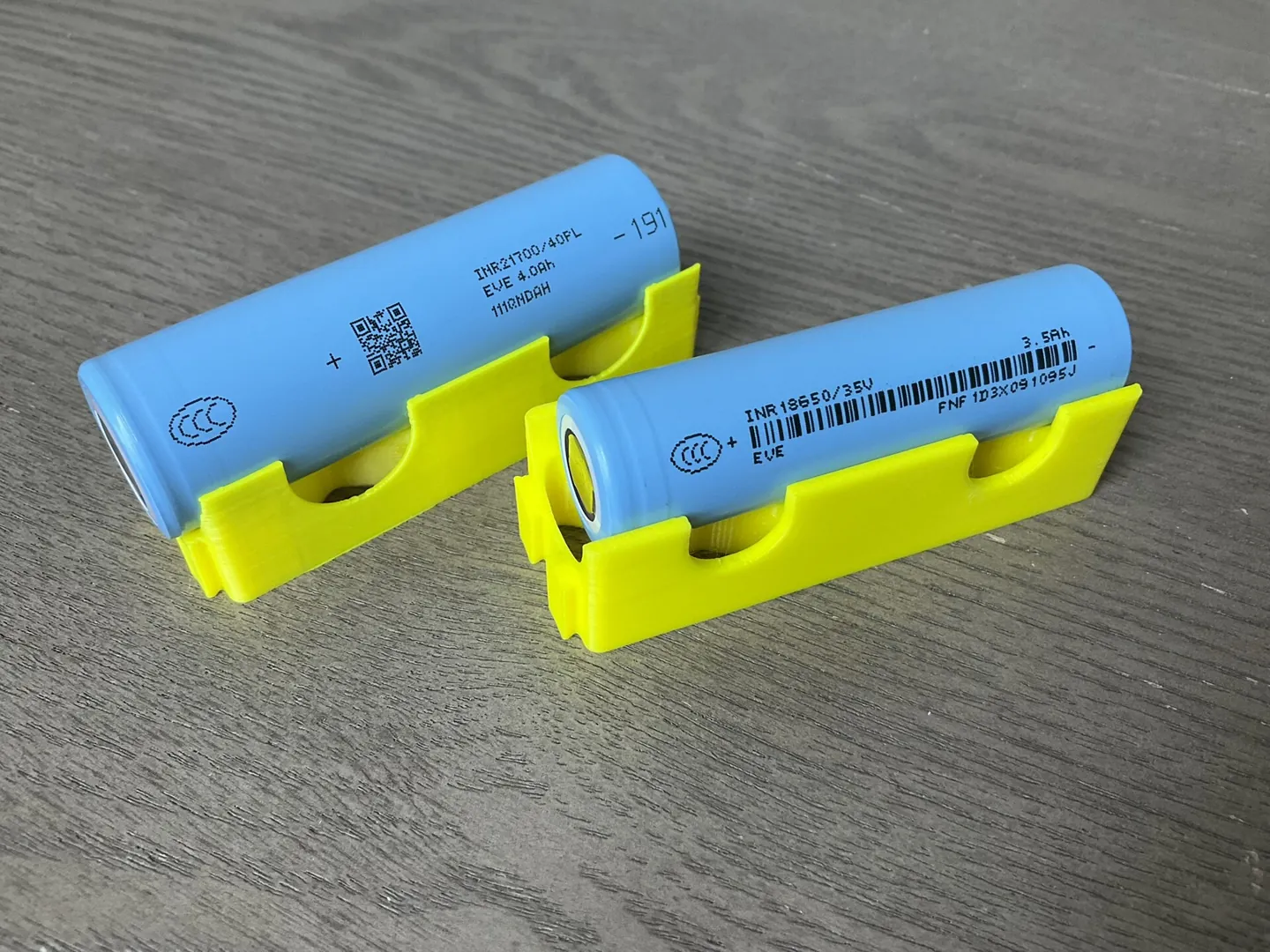
18650 and 21700 lithium ion battery cell.jpg — Sevenethics; CC0. Resized and converted to WebP; source: https://commons.wikimedia.org/wiki/File:18650_and_21700_lithium_ion_battery_cell.jpg
Use the manufacturer's temperature limits
Charging and storage limits are not necessarily the same as operating limits. A device may discharge in cold conditions but prohibit charging at that temperature. Read the exact manual, especially for equipment kept in an unheated shed, car or porch.
Do not warm a battery on a radiator, with a hairdryer or beside a stove. If it has been outside, follow the manufacturer's instructions about returning it to suitable conditions before charging, including any moisture precautions. Never charge equipment that has become wet unless the manufacturer has confirmed it is safe.
Keep stored batteries away from direct sun and extreme temperatures. A car that is convenient for storage may expose a device to conditions outside its limits. Choose the location based on the actual instructions and the household's access needs.
There is no universal "store every battery at half charge" rule for this collection of products. Long-term storage state, checking interval and recharge procedure differ. Write the actual requirement on the inventory so you do not rely on memory months later.
Protect loose cells and keep sets identifiable
Use a suitable protective case or original packaging so terminals cannot touch keys, coins or other conductive objects. Keep batteries away from children and pets. A loose cell at the bottom of a bag is difficult to inspect and easy to confuse with a spent one.
Keep the set used in a particular radio or torch identifiable. Follow the device instructions on matching type, capacity and condition, and avoid mixing fresh and depleted cells. If a set performs poorly, investigate according to the charger and battery guidance rather than repeatedly combining random cells.
Separate "ready", "needs charging" and "awaiting recycling" storage. Use plain labels that everybody understands. Do not put a damaged battery in the normal recycling box while waiting for the next supermarket trip; contact the receiving service about safe handling first.
If you use removable batteries in a device stored for long periods, follow the device manual on removal. Keep the correct spares nearby in protected storage, not loose against the device contacts. Our emergency radio guide helps connect battery maintenance with actual reception and use.
Build a charging routine around real use
Keep a short inventory with the device, battery type, charger location, last check and next manufacturer-recommended action. Do not buy a large reserve that you cannot maintain. A smaller set used and checked regularly may be easier to trust.
Before a forecast disruption, charge sound equipment within its instructions while normal supply is available. Do not leave every battery charging overnight simply because the weather warning feels urgent. Make a priority list of essential communications and lighting. Tie that list to the household power-cut plan so everyone knows which charged devices must remain available for urgent use.
Check that the ready battery actually serves the intended device. A charged power bank without the correct phone cable is an incomplete arrangement. A radio with a low-voltage warning may need investigation rather than an assumption that any rechargeable AA cell is suitable.
Use the kit-review guide for the wider inventory, but use shorter maintenance intervals whenever a battery manual requires them. The calendar review does not override product-specific instructions.
Stop using a battery that shows warning signs
Swelling, leakage, unusual heat, odour, hissing or cracking sounds, and smoke warrant immediate attention. A battery dropped or crushed may also need assessment even when the case appears intact. Do not press a swollen case flat, puncture it or try another charger.
If there is smoke, fire or an escalating battery failure, leave, keep others away and call 999 from safety. Do not pick up a hot, hissing or smoking device to carry it outdoors. Do not attempt to fight a lithium battery fire yourself.
For a cool, stable device with damage but no active failure, stop using or charging it and contact the manufacturer or appropriate waste service for instructions. Do not post it back through ordinary mail without the required authorised arrangements. Keep people away while you obtain advice.
After an electrical incident, use the restoration safety guide before reconnecting equipment. A charger that was wet during a leak does not become trustworthy merely because the room has dried.


Full image attribution
Battery Recycling Container.jpg — Daniel Capilla; CC BY-SA 4.0. Resized and converted to WebP; source: https://commons.wikimedia.org/wiki/File:Battery_Recycling_Container.jpg
Use the right recycling route
Government recycling guidance says batteries and electrical items should go to appropriate collection points, not household rubbish. For removable ordinary spent batteries, follow the collection service's instructions, including terminal protection where required.
A product with a battery that cannot safely be removed belongs in the appropriate electrical recycling stream. Do not dismantle it to fit a small battery collection box. Large packs and damaged batteries may require a specific service, so telephone ahead and describe the item accurately.
Record when a battery is retired and remove it from the ready inventory. Replace it only if the underlying need still exists. If the next purchase will support Digital Voice backup, confirm compatibility with the provider before spending money.
Battery safety checklist
- Identify chemistry, model and device compatibility.
- Keep approved chargers and sound cables with clear labels.
- Charge in a suitable place while awake, clear of escape routes.
- Follow temperature, storage and maintenance instructions for the exact product.
- Protect loose terminals and separate ready cells from spent ones.
- Stop for damage or unusual behaviour; leave and call 999 for smoke or fire.
- Ask the receiving service about damaged or large batteries before transporting them.
- Keep the inventory accurate so unusable batteries are never counted as backup.
Sources
Sources checked on 2 November 2026. Worked examples and household worksheets are illustrative planning aids.
- Scottish Fire and Rescue Service: Lithium-ion batteries. Verified 2 November 2026.
- London Fire Brigade: E-bikes and e-scooters: Fire safety advice. Verified 2 November 2026.
- Office for Product Safety and Standards: Consumer products: recycling batteries and electrical waste. Verified 2 November 2026.
- Panasonic Energy: Eneloop battery FAQ. Verified 2 November 2026.